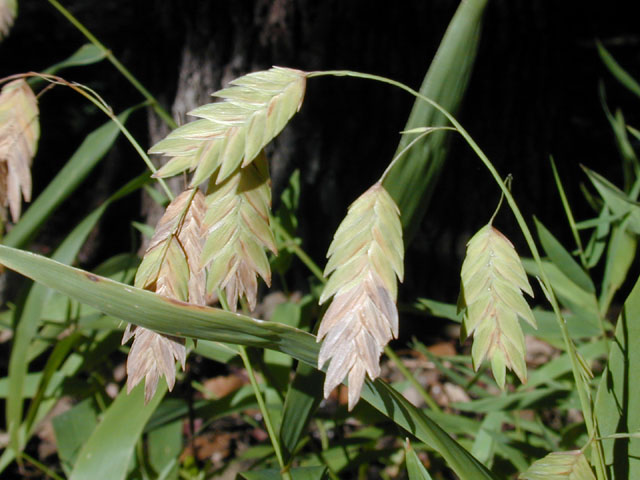
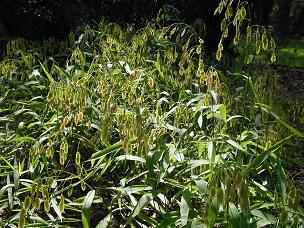
Inland Sea Oats (Chasmanthium latifolium) is a hardy perennial grass best suited for the shade. For the native gardener, it is an unusual grass due to its preference for shade. Their height is about three feet, with a “clump” usually around two feet wide. Visually its golden chevron-shaped seed heads are its most distinguishing feature. It is resilient, not only able to thrive in the shade, but also tolerant of drought and heat.
Native Texan
Native to North Central Texas, Inland Sea Oats endemic range extends from the east coast to a western edge near Wichita Falls, and from the gulf coast to a loose border running from northern Kansas to Virginia. They are indigenous to riverbanks, floodplains, limestone glades, and edges of moist woodlands.
The common name derives from its resemblance, but not relation, to Sea Oats (Uniola paniculata), which are native to the coastal sands along the east coast and the gulf coast. Creativity was not in abundance when it came time for coming up with its most popular common name. Other less popular common names for the plant are more reflective of the plant’s habitat – Indian Wood Oats, Wild Oats, and River Oats.
Seasonal Color Changes
Sea Oats are low maintenance and transplant easily. The leaves are nearly evergreen, turning golden brown in the fall and early winter, before eventually succumbing in mid-winter, and in what feels like a matter of days, it begins again. For a tidier look, a shearing at this time down to the basal rosette does the trick. In addition, Inland Sea Oats seeds also go through color changes, with hues often dependent on the amount of light. From a translucent green to ivory, before darkening and dropping in the winter.
Not surprisingly, it is tolerant of a wide variety of soils and moist areas. One of its strengths is its strong root system. It is an excellent shield against soil erosion. They are a wise choice along streams or water features.
A Friend to Wildlife
Inland Sea Oats is a friend to a host of wildlife. Small mammals and granivorous birds eat the seeds. The leaves are grazed by some mammals and are often used as nesting material by birds. Three Skipper butterflies utilize it as a host plant for their caterpillars.
Below are some ideas for companion plants for Inland Sea Oats – primarily boldly colored perennials that can tolerate some shade:
- Black-eyed Susan (Rudbeckia hirta)
- Butterfly Milkweed (Asclepias tuberosa)
- Cardinal Flower (Lobelia cardinalis)
- Pigeon Berry (Rivina humilis)
- Purple Coneflower (Echinacea angustifolia)
Now, we come to the one area that needs to be addressed directly regarding Inland Sea Oats. If they receive more light than partial shade and plenty of moisture, they have a tendency to get…aggressive. In comparison, they are not as aggressive as invasive plants. However, if they do get assertive, cutting back on water and collecting the seeds in the fall, will reduce their rambunctiousness.
If you lack shady spots or want to contain, a good solution is planting in pots. It will help control them and create a mass of deep green that can complement colorful potted plants.
For beginners to native plants, Inland Sea Oats is a great choice for those tough shady spots in your landscape. With its combination of low maintenance, nearly evergreen leaves, and colorful seeds, it’s a can’t-miss plant for your native garden.